Dementia Training Australia is your gateway to dementia education and training for the Australian workforce.
We work with organisations across Australia to help achieve measurable and sustainable improvements in the care and wellbeing of people living with dementia.
Our offerings may include brokered services that best suit the needs of your organisation.
Custom expertise tailored to suit your organisation
Dementia Essentials
CHCAGE011 Provide Support to People Living With Dementia
Build your team’s expertise or upskill yourself with this fully funded, nationally recognised unit of competency. This course offers skills and strategies to help with communication, planning, developing activities and understanding changed behaviour in people living with dementia.
Nationally-accredited training – RTO Code: 2512
Certificate of Attainment
Cost-free for learners
Available to complete online or face-to-face
Suitable for:Australians working in aged care, health care and community services
Course location:
We may be able to run Dementia Essentials in-house at your organisation or as part of a Commissioned Training (minimum participant numbers apply).
Individuals may attend a course nearest to them. Dementia Essentials courses are held year round, across all Australian states and Territories.
This DTA course is delivered throughout Australia by consortium member, Dementia Australia
Dementia-friendly Environments
Our award-winning Environments Consultancy can help you use your existing environment more effectively, plan a new facility or refurbish an existing one.
Onsite education
Training on how to use assessment tools
Support for creating changes, big or small
A dementia-friendly environment is enjoyable and meaningful, taking into account a person’s lifestyle, background and interests, as well as being familiar and recognisable.
We provide onsite education, training on the use of environmental assessments and support staff and leadership to recognise and plan meaningful environmental changes.
Conduct a web-based survey of your staff, managers and optionally consumers, to identify the training needs at your organisation.
Easy to use web-based survey
Engage with your team
Receive a snapshot of perceptions
We use the TNA survey to identify priorities and goals within an organisation. Based on our finding, we present you with a menu of education options which may include resources, courses and services (including those from 3rd party suppliers) to best meet your needs.
Build your teams teaching skills and share knowledge. Deliver workshops and dementia education sessions at your workplace with our train the trainer materials.
Deliver education at your workplace
Free to download and use
Self-directed education, no time limits
Facilitator materials are available for some learning areas, and compliment DTA learning modules.
We use the TNA survey to identify priorities and goals within an organisation.
understand your organisations training needs
build a training program tailored to you organisation
evaluation of the effectiveness of the training
We use the TNA survey to identify priorities and goals within an organisation. Based on our finding, we present you with a menu of education options which may include resources, courses and services (including those from 3rd party suppliers) to best meet your needs.
What’s included?
This service commences with a guided conversation exploring:
a range of factors known to contribute to delivery of high quality care
how training can assist in getting these right
organisational preferences, e.g. training modality, timing
If an agreement to provide training is reached, the TNA Service will then extend to an assessment of the dementia-related knowledge and skills of a sample of the staff to be trained.
Understand Changed Behaviours and find ways to reduce them
Commissioned Training
Dementia Training Australia partners with organisations who are looking for a comprehensive training program commissioned to fit the unique needs of their staff and organisation.
About the service
A guided conversation with one of our training consultants to identify your staff training needs.
A menu of training recommendations, tailored to meet your needs.
Training that assists in building capability and confidence across teams that may comprise of:
Online Learning
Consultancy Services
Workshops
Access to training and resources from a range of providers
Individually tailored to meet your staff’s unique needs and vary in duration and modes of delivery
Our Commissioned Training are available across Australia
Suitable for a wide range of organisations including residential aged care facilities, community aged care organisations, health services and hospitals
Are you ready to create real and lasting change at your organisation?
Dementia touches families, carers and whole communities. With 2 in 3 people living with dementia in Australia continuing to live in the community, and this number expected to more than double by 2058, the need for informed, compassionate and community-based care has never been greater.
Whether you’re a family member, frontline worker, manager or care planner, our training give you the skills, knowledge and support to make a real difference.
As the leading provider of dementia training in Australia, our free, evidence-based training can be tailored for every care setting and completed at your own pace.
Explore the resources below so you can deliver dementia care with confidence 👇
Dementia Dialogues with DTA offers quick, practical insights into dementia care, education, and training, designed to support both people living with dementia and the staff who care for them.
Join us as we explore key topics, share lived experiences, and provide practical tools to help create dementia-friendly communities and care environments.
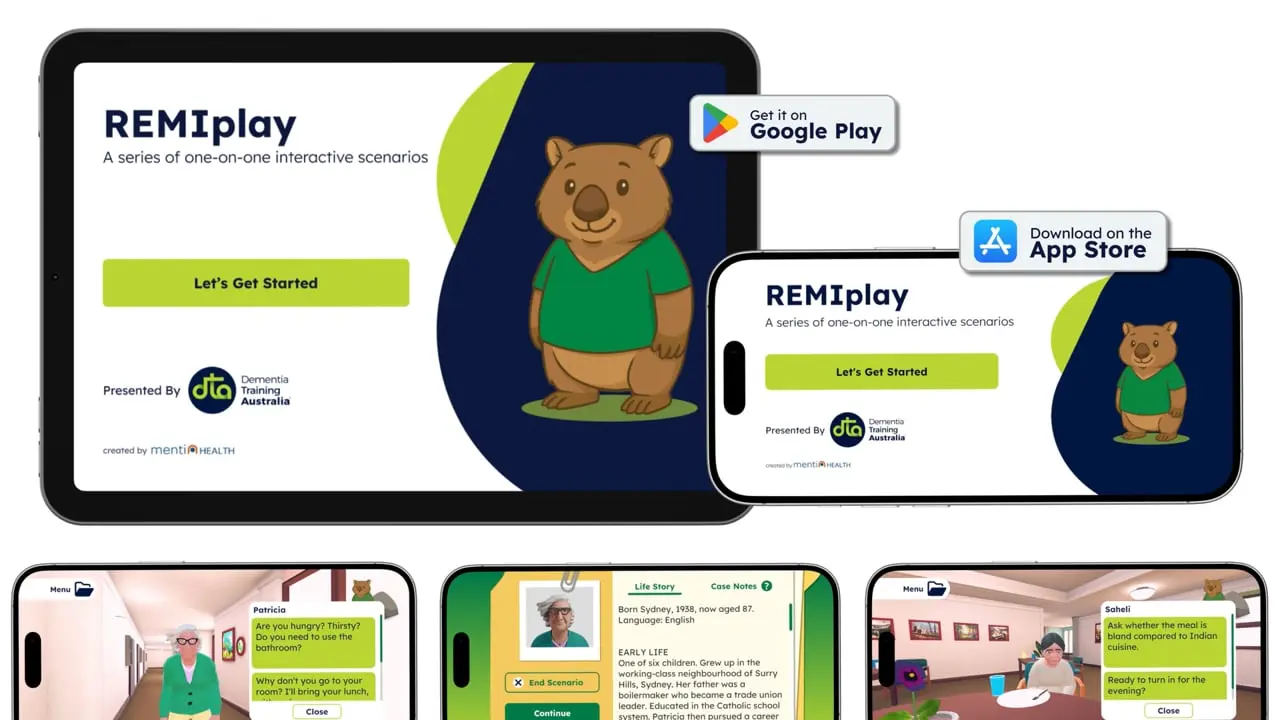
Accessible anytime, anywhere on your device, REMIplay™ makes it easy to learn, practise and refresh your skills.
Through short, real‑life scenarios, you can safely practise your skills alongside our friend REMI the Wombat. REMI joins you every step of the way to share advice and improve your confidence in providing best-practice dementia care.
Our Caring at Home hub brings together some of Dementia Training Australia’s evidence-based training and trusted resources, curated specifically for family carers.
Childhood dementia is rare, but it’s life-limiting and deeply impacts families. In this 30-minute course, you’ll learn what childhood dementia is, how it may present, and how it affects children and their families.
This course is designed to provide easily accessible dementia care education for Volunteers who are supporting people living with dementia or experiencing memory and thinking problems.
This online course is designed for first responders to gain a better understanding of dementia including common symptoms and how dementia affects the brain and behaviour.
Delirium is a serious medical condition producing sudden and often severe changes in a person’s mental function. A person typically has difficulty thinking clearly, maintaining focus or attention, and may appear confused or disorientated. Delirium needs to be recognised early and managed promptly.
Tier
Foundational
Duration
2 hrs 30 mins
Delivery
100% online
Certificate
Certificate provided
Cost
Free
Dementia Training Action plan
Take the first step in strengthening your dementia care expertise with the Dementia Training Action Plan (DTAp). Using the National Dementia Education and Training Standards Framework (NDETSF) Domains and Tiers, this simple self-assessment tool helps you identify your current knowledge and skills, highlight areas for growth, and create a personalised learning pathway.
Start your assessment today and take control of your dementia care learning journey!
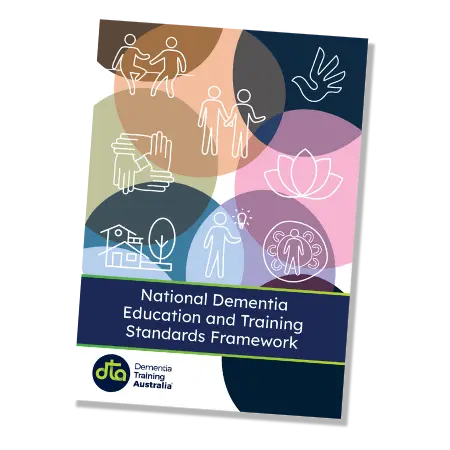
National Dementia Education and Training Standards Framework
Endorsed by the World Health Organization, enhance your dementia care knowledge and skills today!
The National Dementia Education and Training Standards Framework (NDETSF) will improve the consistency and quality in education and training. The Framework ensures that all Australians living with dementia, regardless of care setting and location, receive high-quality, evidence-based support and care that enhances their health and wellbeing.
The NDETSF was commissioned and funded by the Department of Health, Disability and Ageing and developed by Dementia Training Australia.
We offer a range of training options to enhance your dementia care. Whether you need an online course, trainer resource, face-to-face workshop, or in-depth consultancy, we have a level and format to suit your education needs.
Suitable for all allied health professionals including physiotherapists, occupational therapists, social workers, music therapists, dieticians, speech pathologists, podiatrists, pharmacists, optometrists, and more.
Learn and be inspired by fellow allied health professionals who spoke at our #UnitedforDementiaCare Symposium.
UNITED: Allies in Care
Speaker: Vicki Barry, Care Partner, Young Onset Dementia Advocate, Network Orchestrator
After 12 years of being a single mum, marriage brought renewed hope and dreams of an easier life ahead. Life was good for a while and then it changed. Using the acronym UNITED to frame her presentation, Vicki will share her personal experiences supporting her partner Michael to live the best life possible with Alzheimer’s disease, working with a range of allied health professionals to achieve this.
Fall Prevention for Community-Dwelling Older People Living With Dementia: An Exercise and Home Hazard Reduction RCT
Speaker: Dr Morag Taylor Senior Lecturer, Physiotherapy, School of Health Sciences, Faculty of Medicine & Health, UNSW, Conjoint Senior Research Fellow at Neuroscience Research Australia, Falls, Balance and Injury Research Centre
The iFOCIS RCT aimed to determine the fall prevention efficacy of two allied health interventions: a home hazard reduction and home-based exercise program, in community-dwelling older people living with dementia. Three hundred and nine people participated in the 12-month trial with a multidisciplinary team leading the study. The primary outcome was rate of falls. Results and learnings will be presented.
Delivering a ‘Better Way To Care’ in Hospitals for People With Dementia
Speaker: Ellie Newman Dementia Lead and Head of Physiotherapy, Armadale Kalamunda Hospital, East Metropolitan Health Service, WA
This presentation will showcase various quality improvement initiatives led by allied health staff in Australia’s first Metropolitan Health Service to be recognised as working towards being dementia friendly.
Kicking Mealtime Goals Using a Multidisciplinary Approach: The Role of Allied Health in Maggie Beer’s Big Mission
Speaker: Elizabeth Oliver Occupational Therapist, Curtin University
Maggie Beer’s Big Mission is a social experiment designed to enhance the mealtime experience for older adults living in residential care. Join Occupational Therapist and Project Leader, Elizabeth Oliver, as she describes how changes to meals and dining experiences can have transformational effects and reciprocal benefits for residents, staff, and the culture of care. Elizabeth will demonstrate how an embedded model of allied health that encompasses a multi-tiered system of supports can foster culture change and enhance quality of care.
Supporting Transitions of Care: Dementia Friendly Ambulance Services
Speaker: Lindsay Bent ASM OStJ Churchill Fellow Clinical Lead, Communications Centres Specialist Operations and Coordination Ambulance Victoria
Australian ambulance services are acutely aware of the impact dementia has on an individual and their carers but has made little progress to directly address this issue. This presentation will provide an overview of learnings through a Winston Churchill Fellowship, how ambulance trusts in the UK have worked towards becoming more dementia friendly, the key drivers for change and the learnings for allied health professionals.
Allied Health Symposium – “Huddle Up” Panel Discussion
Previous speakers will come together to discuss the presentations from the morning and reaffirm the role of allied health in achieving safe and high-quality care for people living with dementia, including supporting successful transitions of care across the care continuum.
Beyond Age: Understanding Childhood Dementia and Its Unique Challenges
Speaker: Megan Maack, CEO of Childhood Dementia Initiative
While dementia is typically associated with aging, a growing understanding of childhood dementia is reshaping our approach to caring for impacted children. This talk will explore the unique challenges and care needs of children affected by dementia, offering allied health professionals’ crucial insights into this often-overlooked group of conditions. Learn how your expertise can make a vital difference in supporting these children and their families.
Stepping Up for the Team: Advocating for Communication and Connection in Dementia Care
Speaker: Associate Professor Jade Cartwright, School of Health Sciences, University of Tasmania
This presentation will empower allied health professionals, with a particular focus on speech pathology, to address the communication needs of people with dementia and their families, emphasising the importance of giving voice, fostering cohesive teamwork, and building connections.
Educational and Public Health Approaches to Dementia Risk Reduction
Speaker: Professor James Vickers, University of Tasmania and Director of the Wicking Dementia Research and Education Centre
There has been significant progress in knowledge about the potentially modifiable risk factors for dementia, however, public understanding of dementia risk is limited. This presentation will review educational and public health approaches to reducing dementia risk in the community, highlighting areas that fit within the scope of practice of allied health practitioners.
Understanding and Reducing Dementia Risk: Translating Research into Allied Health Practice
Speaker: Professor Blossom Stephan, Chair in Dementia (Curtin University and Dementia Australia) and Director of the Dementia Centre of Excellence
Discover how epidemiological research findings have been translated into dementia risk assessment models for use in clinical practice, including evidence-based prevention strategies targeting the key modifiable risk factors for dementia. A practical framework for implementing risk reduction interventions across allied health practice, focusing on lifestyle, social, and health risk factors will also be presented.
Connecting People, Connecting Support. A Ten-Year Story of Transforming the Allied Health Professions’ Contribution to Supportin
Speaker: Professor Elaine Hunter, National Allied Health Professions Consultant, Alzheimer Scotland Visiting Professor, Edinburgh Napier University
Connecting People, Connecting Support (Alzheimer Scotland 2017, 2020, 2024) is an evidence based allied health professional (AHP) dementia policy in Scotland that outlines how AHPs can support people living with dementia and their families with 4 ambitions to transform practice and integral to Scotland’s Dementia Strategy. To integrate national policy to local practice for the benefit of people with dementia and their supporters, a co-ordinated implementation model was developed. The presentation will share context, a whole-system tailored-delivery model that integrates rehabilitation into the AHP offer, progress to date, key enablers for change, implementation gaps and our priorities for the next 24 months. The presentation will consider if an allied health professional policy in dementia could be transferable to meet the needs of people with lived experience in Australia.
Multicomponent Allied Health Interventions for People With Dementia
Speaker: Associate Professor Nathan D’Cunha, Dementia and Cognition Theme Lead, Centre for Ageing Research and Translation, University of Canberra
There is increasing evidence that multicomponent interventions help people with dementia live well after diagnosis and provide essential support to their care partners. One example in the ACT is the allied health led Sustainable Personalised Interventions for Cognitive, Care, and Engagement (SPICE) program based at the University of Canberra Hospital. SPICE is a combination of evidence-based interventions which includes group and individual components over ten weeks. This presentation will describe the program, its benefits, and challenges to implementation.
The Right to Rehabilitation for People Living With Dementia: Tackling Stigma and Implementing Evidence-Based Interventions
Speaker: Professor Michele Callisaya, Menzies Institute for Medical Research, University of Tasmania and National Centre for Healthy Ageing, Monash University
The presentations will outline Dementia rehabilitation as a human right, the barriers in accessing rehabilitation and solutions co-designed in this project to improve access.
Rehabilitation and Reablement for People Living With Dementia: How Can We Do It In Practice?
Speaker: Dr Claire O’Connor, School of Psychology, UNSW; Neuroscience Research Australia; HammondCare
Allied health professionals and other stakeholders with an interest in rehabilitation and reablement in dementia have recently participated in a national survey process. Outcomes from this process will be presented, including discussion around the identified enablers and barriers to implementing these allied health interventions in practice, and the strategies developed to support effective implementation.
Online Courses
Discover courses relevant for allied health professionals below or browse all courses.
Raise awareness, change attitudes, and present evidence for the need and provision of rehabilitation as part of post diagnostic care for all people with dementia and their care partners
This course is designed to provide easily accessible dementia care education for Volunteers who are supporting people living with dementia or experiencing memory and thinking problems.
This online course is designed for first responders to gain a better understanding of dementia including common symptoms and how dementia affects the brain and behaviour.
Dementia Training Australia (DTA) is proud to present Dementia Dialogues with DTA; a podcast to help those in the dementia care space. Our episodes…
Type
Podcast/Audio
Medication Management Consultancy
A Consultancy Program Designed by Pharmacists
Consultant-led mentoring and education
Personalised Antipsychotic Prescribing Procedure and Sustainability Plan
Virtual classroom session on behaviour support planning
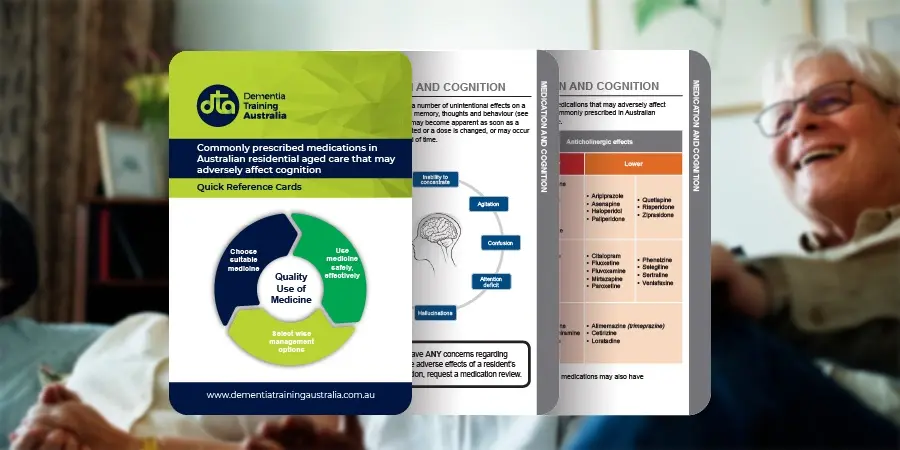
The Medication Management Consultancy service helps reduce unnecessary reliance on antipsychotic and psychotropic medicines, ensuring they’re used only as a last resort, at the lowest effective dose, and for the shortest time possible.
We specialise in building a tailored, capacity-building education that enhances staff knowledge and promotes sustainable, facility-wide changes. Partner with us to develop effective strategies for responsible medicine use and improve person-centred care for older people living with dementia.
The Medication Management Consultancy is a consultant-led service designed to support residential aged care organisations in establishing a sustainable framework for the quality use of antipsychotic and psychotropic medicines.
This consultancy focuses on ensuring these medicines are used only as a last resort, at the lowest effective dose, and for the shortest possible duration.
benchmarking to measure staff knowledge and antipsychotic medicine use before and after the program.
Resources to guide appropriate use of antipsychotic and psychotropic medicines.
Education and advice from a DTA consultant.
The consultancy follows a validated, evidence-based process:
Completes an audit to assess current medication practices.
Tracks progress to ensure lasting change.
Tailored education and training for staff.
Ongoing support and resources to encourage improvement.
Benefits:
May count towards professional development (CPD) points.
Help meet Australian Aged Care Quality Standards (Standards 3, 7, and 8).
Help improve mandatory Quality Indicator Program (QI Program) reporting statistics.
Free hard copy resources.
Continuing Professional Development
A program certificate will be issued for completing the e-Learning course and attending a virtual classroom session and five virtual meetings with a DTA consultant. The certificate will include hours of attendance and equivalent Continuing Professional Development (CPD points).
Medication Management Consultancy
The Medication Management Consultancy is a consultant-led service designed to support residential aged care organisations in establishing a sustainable framework for the quality use of antipsychotic and psychotropic medicines. This consultancy focuses on ensuring these medicines are used only as a last resort, at the lowest effective dose, and for the shortest possible duration.
How It Works
The consultancy follows a validated, evidence-based process:
Completes an audit to assess current medication practices.
Tracks progress to ensure lasting change.
Tailored education and training for staff.
Ongoing support and resources to encourage improvement.
Dementia Training Australia is supported by funding from the Australian Government under the Dementia Training Program
Medication Management
We provide a variety of training options designed to minimise the use of antipsychotic and psychotropic medicines in people living with dementia. Whether you’re looking for an online course, resource tools, interactive workshops, or comprehensive consultancy, we offer a range of levels and formats to meet your educational needs.
Personalised Antipsychotic Prescribing Procedure and Sustainability Plan
Virtual classroom session on behaviour support planning
The Medication Management Consultancy service helps reduce unnecessary reliance on antipsychotic and psychotropic medicines, ensuring they’re used only as a last resort, at the lowest effective dose, and for the shortest time possible.
We specialise in building a tailored, capacity-building education that enhances staff knowledge and promotes sustainable, facility-wide changes. Partner with us to develop effective strategies for responsible medicine use and improve person-centred care for older people living with dementia.
Explore the role that benzodiazepines and other sedatives play in supporting a person living with dementia who may be experiencing a changed behaviour.
Learn how you can support the deprescribing process in older people living with dementia.
Tier
Enhanced Practice
Duration
1 hr
Delivery
100% online
Certificate
Certificate provided
Cost
Free
Behaviour Support Planning for Changed Behaviour: A Case Study
This workshop will build your capacity to develop behaviour support plans and minimise antipsychotic use for people living with dementia who experience changed behaviour.
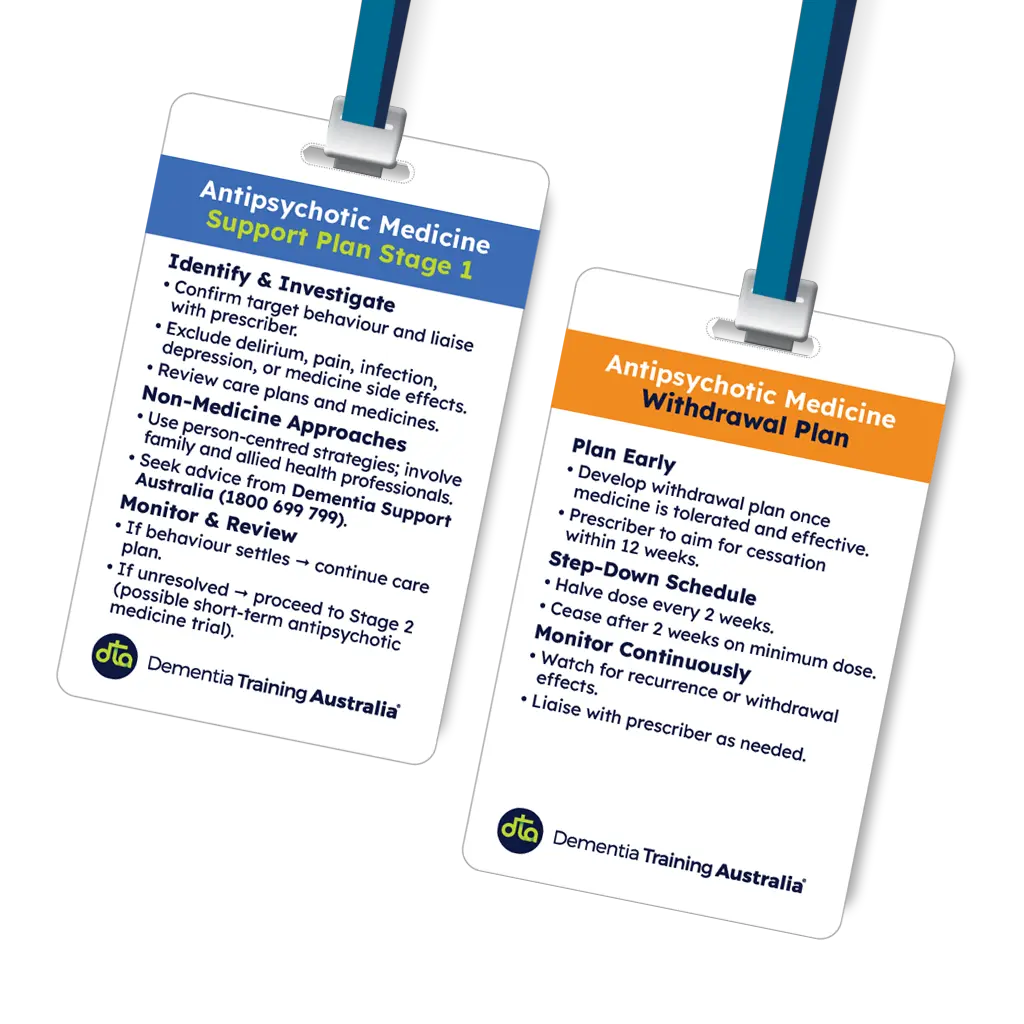
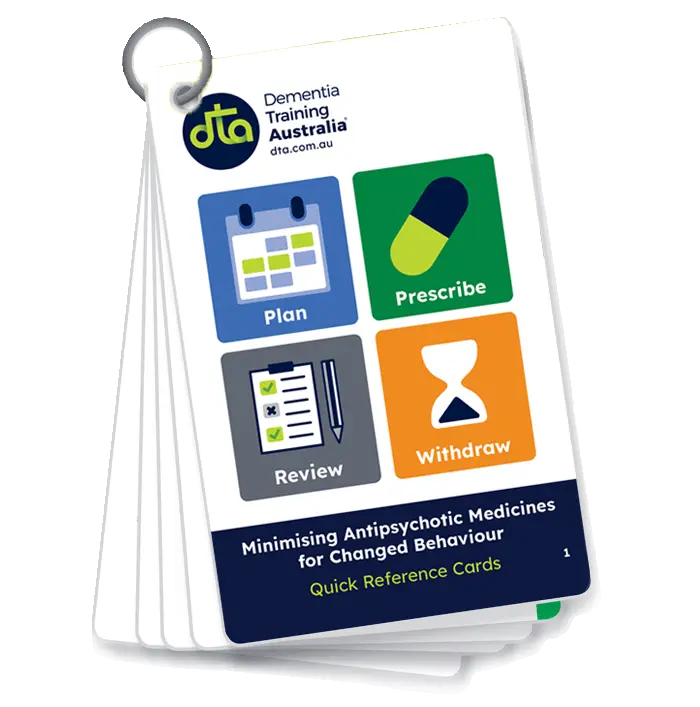
This evidence-informed resource is designed to assist health professionals or support staff to minimise antipsychotic use for change behaviour and to ensure safe and appropriate usage if these medicines are prescribed, as a last resort and when all non-medicine approaches have failed.
This evidence-informed resource is designed to assist health professionals or support staff to minimise antipsychotic use for change behaviour and to ensure safe and appropriate usage if these medicines are prescribed, as a last resort and when all non-medicine approaches have failed.
We train design, property management and care professionals to collectively help create supportive environments for people living with dementia and other aged-related dispositions.
Environments Training Program
Our consultancy service can help you create a dementia-friendly environment.
Available nationwide
Learn how to use an existing building more effectively, plan a refurb, or build new
A multimodal, scaffolded approach to training
Building on National Design Principles and Guidelines
Environments matter to people living with cognitive and physical impairments. Some buildings and outdoor areas present barriers, others reinforce retained abilities and invite opportunities for meaningful activity.
DTA partnered with the Department of Health, Disability and Ageing to develop National Design Principles and Guidelines in response to recommendations made in the Royal Commission into Aged Care Quality and Safety.
The guidelines our programs and resources are structured upon have been built over four decades of research and reflective practice.
These guidelines outline how residential care environments can best support the people who live there, especially those living with dementia.
This program empowers workforce to transform institutional aged care homes into places that support residents by created opportunities for meaningful life.
We train your staff to create supportive environments, whether that means working with what you have or planning a refurbishment. It starts with a team of staff who want to explore their pivotal role in ‘remaking’ environments around the needs of residents. The end result might be a place that people can move around more easily, get outdoors or make a cup of tea.
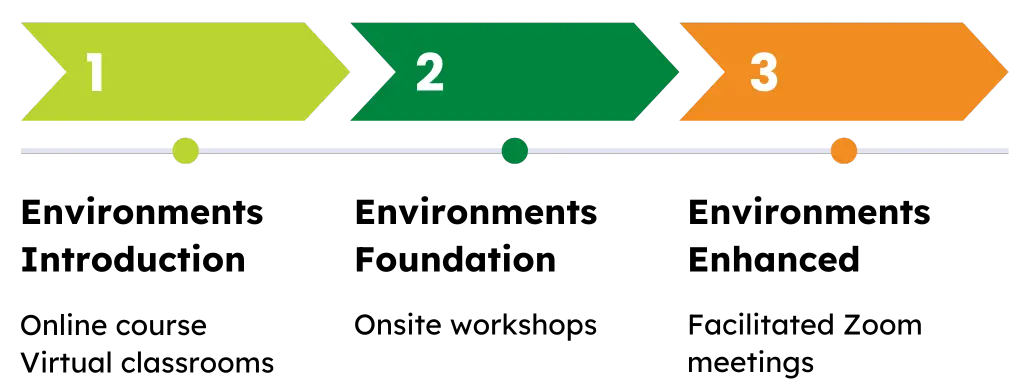
The program is structured around three stages of project-based learning from group formation to the application of evidence-based practice. It is tailored to your organisation with a mix of online learning, virtual classrooms, and site-based training.
As the program progresses our trainers come to your site to work with your team in a manner that focuses on their reality. The program lasts between one and six months depending on your need and preferences and is available nationwide for metro, rural and remote sites.
By taking part in this program, you’ll not only transform your organisations physical spaces, but also positively impact the lives of those in your care.
The DTA Environment Activity Cards aim to spark conversations among staff, residents and visitors about residential aged care and retirement living buildings.
We are about to repaint our facility, what colours should we pick? What sort of furniture should we choose? How can we make our outside spaces more dementia friendly? What type of signage can help with wayfinding?
Type
Toolkit
Are you ready to create real and lasting change at your organisation?
DTA provides a range of services and support to organisations. Our specially appointed field experts will support your staff to put new knowledge and skills into practice at your workplace.
Dementia Training Australia partners with organisations who are looking for a comprehensive training program commissioned to fit the unique needs of their staff and organisation.
DTA provides a range of services and support to organisations. Our specially appointed field experts will support your staff to put new knowledge and skills into practice at your workplace.